

Behind the Code: Who’s Really Keeping Drupal Moving?


Mobomo engineer Stephen Mustgrave is among the contributors doing some of Drupal core’s most sustained work. The numbers behind that achievement tell a larger story about the health of open source and the organizations that invest in it.
Open source software may be freely available, but maintaining it is anything but free. Behind every Drupal release are people reviewing issues, testing changes, maintaining subsystems, resolving blockers, and helping other contributors move good work forward.
Stephen Mustgrave is one of those people. Known as smustgrave in the Drupal community, the Mobomo engineer has quickly become a significant contributor to Drupal core in a relatively short period of time.
New data from Drupal founder Dries Buytaert’s Drupal core metrics dashboard puts that contribution into perspective:
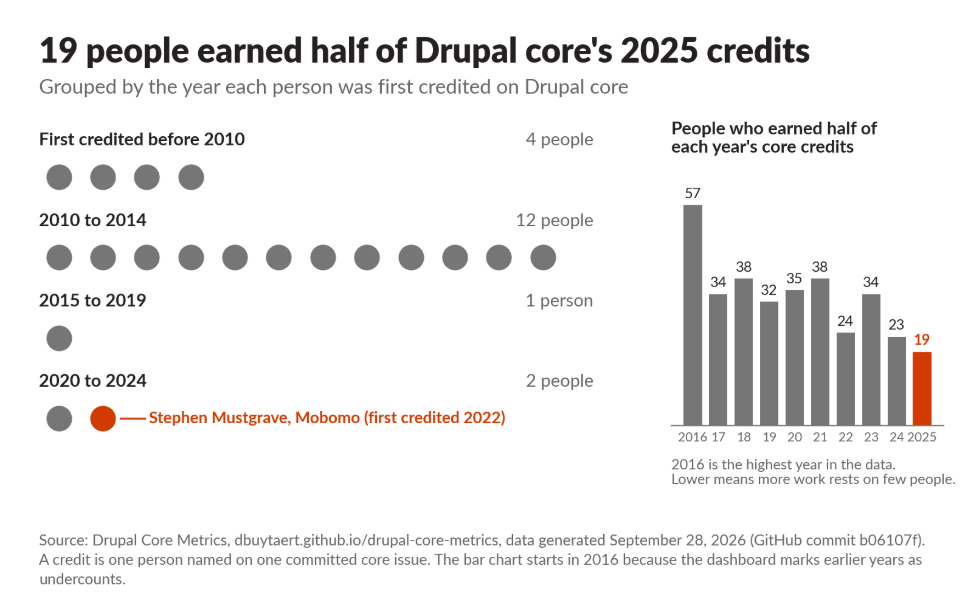
The numbers reveal more than an individual achievement. They also point to a growing concentration of Drupal Core contribution among a relatively small group of people, a trend the dashboard identifies as a potential risk to the project.
Stephen earned his first Drupal Core credit in 2022. Three years later, he was among the 19 contributors whose combined credits represented half of Drupal Core’s 2025 total.
Most of that group has a much longer history with Core. Sixteen first earned Core credit before 2015. Only two first appeared between 2020 and 2024, and Stephen is one of them.
The dashboard does not rank those contributors individually. What it does show is how quickly Stephen has become a significant part of Drupal Core’s contribution community.
What contribution looks like behind the number
A Drupal credit isn’t simply a count of code commits. Open-source development also depends on reviewing issues, testing changes, maintaining subsystems, resolving blockers, and helping other contributors move work forward.
Stephen’s public Drupal record reflects that breadth. Drupal Core’s MAINTAINERS file identifies him as a subsystem maintainer for multiple areas of Core, and his Drupal.org profile reflects extensive project-maintenance work. He has also participated in the Needs Review Queue Initiative, which was created to help reduce the amount of time Core issues wait for review.
Mobomo pays Stephen and allocates engineering time for Drupal contribution. That is deliberate. We build and support Drupal platforms for organizations that depend on them every day, so investing in the ecosystem is both community stewardship and an investment in the technology our clients rely on.
The bigger picture: Drupal Core depends on a smaller group
The trend behind Stephen’s achievement matters, too. The dashboard shows that the number of people accounting for half of Core credits has generally declined from 57 in 2016 to 19 in 2025. It describes a lower number as riskier because more of Core’s work depends on fewer people.
For organizations that rely on open source, that distinction matters. Using the software is only one side of a healthy ecosystem. Giving people the time and organizational support to improve it is the other.
Drupal development is also expanding beyond Core
Contributor concentration is only one story in the data. The dashboard also shows significant development activity occurring beyond Core, particularly across Drupal’s strategic initiatives.
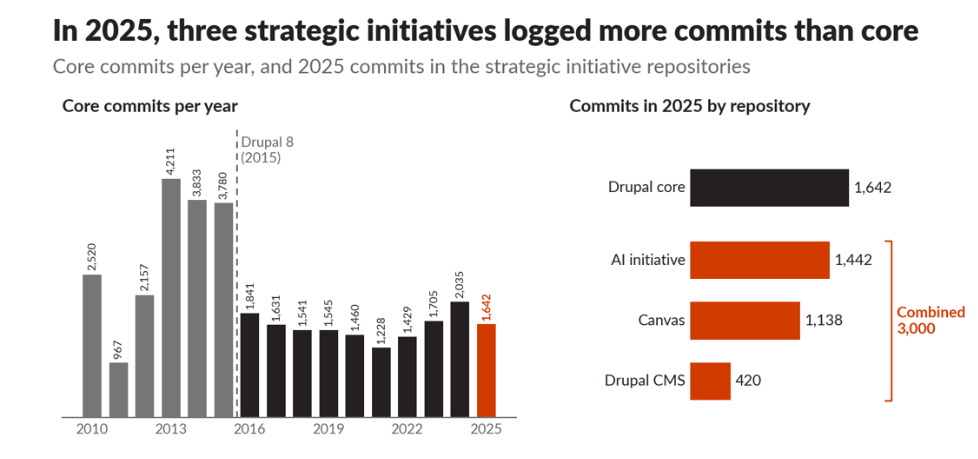
In 2025, the AI initiative, Canvas, and Drupal CMS collectively logged 3,000 commits, compared with 1,642 in Core. These are not apples-to-apples measures of product size or importance; the initiatives span their own repositories. But they illustrate the amount of work underway in major areas of Drupal’s future, from AI capabilities to visual page building and the marketer-focused Drupal CMS experience.
Core itself remains active, with annual commits holding relatively steady since Drupal 8 shipped in 2015.
A glimpse at the engineering underneath Drupal
The metrics also reveal something users rarely see: the engineering infrastructure behind the platform. As of September 2026, Drupal Core contained 468,929 lines of test code compared with 282,791 lines of production PHP. In fact, Core has had more test code than production code in every dashboard snapshot since January 2016.
More test code does not automatically mean better software, but the scale offers a glimpse into the testing and maintenance behind Core. For contributors like Stephen, advancing Drupal is not simply about adding features. It also means reviewing, testing, maintaining, and continually improving a large codebase.
Turning the business case for contribution into practice
At Drupal GovCon last year, Stephen presented “Government Drives Drupal: Why Public Sector Involvement Matters in Open Source,” exploring how organizations can make the business case for contribution, allocate resources to it, overcome institutional barriers, and treat upstream contribution as both stewardship and effective resource management.
For Mobomo, that conversation is not theoretical. We give Stephen paid time to contribute.
That investment also brings experience back to our clients. Contributors working deeply within the ecosystem see how issues are evaluated, how changes move through review, where maintainability challenges emerge, and how the platform itself is evolving.
Open source moves forward when organizations participate
Stephen’s contribution is worth celebrating. But the larger story in the data is not that Drupal needs 19 people carrying so much of the work. It is that healthy open source needs more organizations willing to give talented people the time and support to participate.
For Mobomo, contributing to Drupal is not separate from building with Drupal. It is part of sustaining and advancing the technology our clients, our engineers, and the broader community rely on.
About Mobomo
Mobomo, a private company headquartered in the D.C. metro area, is a CMMI Dev Level 3, ISO 27001:2022, ISO 9001:2015, and CMMC Level 2 provider of digital transformation system integration services. A Drupal Diamond Certified Partner and premier provider of mobile, web, infrastructure, and cloud applications to federal agencies and large enterprises, Mobomo combines leading-edge technology with human-centered design and strategy to craft next generation digital experience. From private sector companies to government agencies, we have amassed deep expertise helping our clients enhance and expand their existing web and mobile suite. Interested in learning more about Mobomo? Take a tour of our capabilities, our portfolio of work, and feel free to reach out with any questions you might have.